

Posted on Friday, July 24th, 2026 at 1:00 pm
Understanding GPS Use Behind the Wheel in Georgia
Key Takeaways: Yes, using GPS navigation is legal in Georgia under the Hands-Free Georgia Act (O.C.G.A. § 40-6-241), but only if the driver never holds or supports the device with any part of the body. The law allows phones and electronic devices for navigation when mounted and operated hands-free, while banning holding a phone or watching non-navigation video. Violations carry escalating penalties, starting at $50 and one license point for a first conviction, with stricter rules for commercial drivers. A hands-free violation can serve as evidence of negligence in an injury claim, establishing a breach of the duty of reasonable care. Understanding this distinction protects both against penalties and in pursuing a future claim.
Yes, using GPS navigation is legal in Georgia, but only if you never hold or support the device with any part of your body. Georgia’s hands-free law expressly carves out an exception for GPS navigation, allowing drivers to use their phone or electronic device for navigation purposes, provided they do not physically hold the device. For anyone driving through Alpharetta and the greater Atlanta metro, understanding this distinction matters for avoiding citations and protecting future injury claims.
If you or a loved one were hurt in a crash involving a distracted driver, the team at Jonathan R. Brockman, P.C. is ready to help. Call our office at 678-343-2081 or request a free case evaluation to discuss your options.
What the Hands Free Georgia Law Actually Requires
The hands free Georgia law centers on a single principle: your hands stay off the device. Codified at O.C.G.A. § 40-6-241, the statute restructured how drivers may interact with phones and electronic devices on state roadways. The Hands-Free Georgia Act was signed into law on May 2, 2018, and took effect on July 1, 2018.
The Ban on Holding a Device
The statute prohibits physically holding a phone while driving. Under O.C.G.A. § 40-6-241(c)(1), while operating a motor vehicle on any highway of this state, no individual shall physically hold or support, with any part of his or her body, a wireless telecommunications device or a stand-alone electronic device. This means a driver cannot cradle a phone in a hand, wedge it against a shoulder, or prop it on a lap, even briefly at a red light. The law does not apply when the vehicle is lawfully parked.
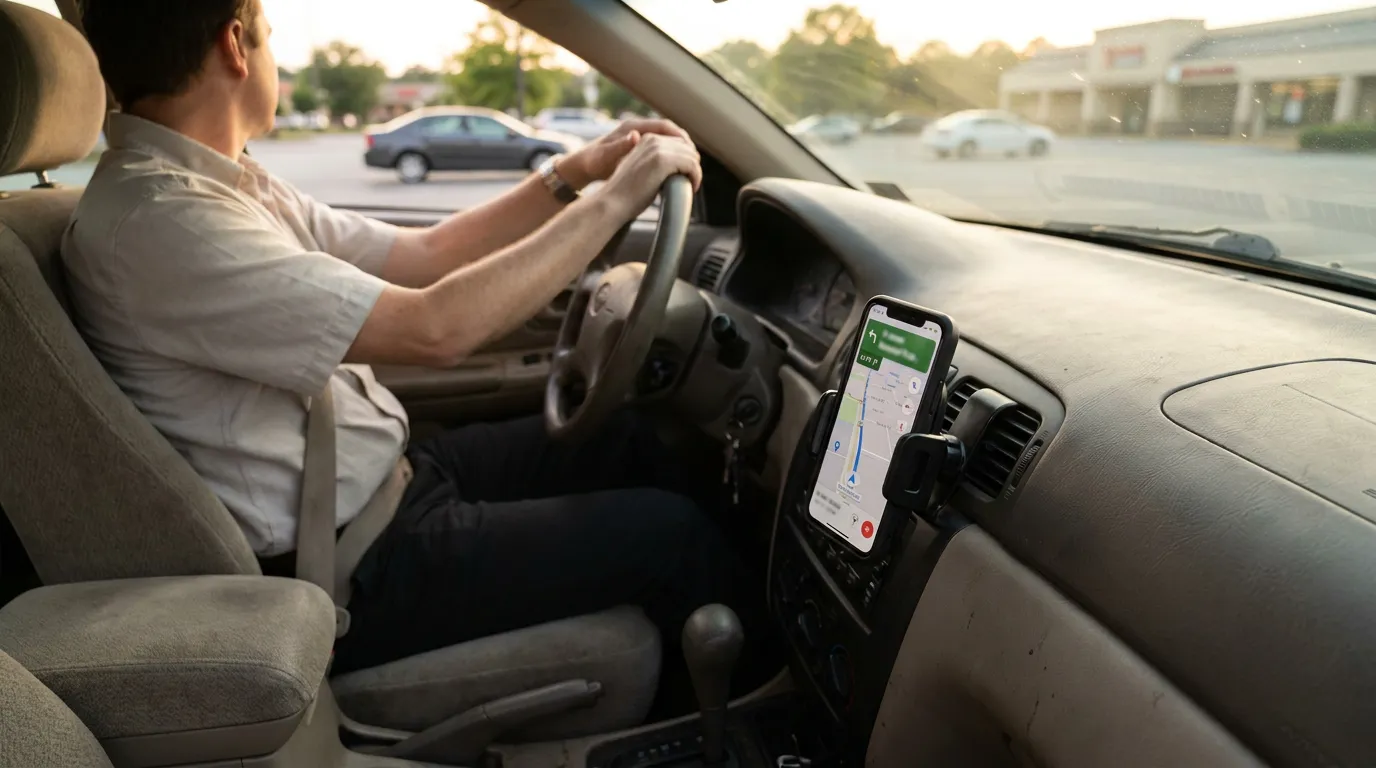
💡 Pro Tip: A dashboard or vent mount is one of the simplest ways to stay compliant. If your device is secured and you are not touching it to hold it in place, you are far less likely to draw a citation.
The GPS Navigation Exception
Navigation use is specifically protected under the statute’s text. Under O.C.G.A. § 40-6-241(c)(2)(B), the prohibition on writing, sending, or reading text-based communications shall not apply to the use of such device for navigation of the vehicle or for global positioning system purposes. The Georgia Governor’s Office of Highway Safety explains the practical scope of these hands-free GPS rules for everyday drivers.
The navigation exception is narrow and does not reopen the door to general phone use, the driver still may not physically hold the device to program it while moving. In-vehicle navigation systems fall entirely outside the law’s scope, as the definition of a regulated wireless telecommunications device explicitly excludes in-vehicle navigation systems.
Common Ways Drivers Still Break the Rules
Even with a lawful navigation exception, drivers frequently cross the line without realizing it. The GPS carve-out covers navigating, not everything a phone can do. Activities that remain off-limits include:
-
Watching video content, drivers may not watch a video or movie on a device other than data related to the navigation of the vehicle.
-
Recording or broadcasting video, though the prohibition does not apply to devices used solely for continuously recording video, such as a dashcam.
-
Reaching for or physically holding the device to interact with it, rather than glancing at a mounted screen.
On-screen mapping guidance is expressly allowed. Using a device for GPS navigation is permitted under Georgia’s hands-free law, including viewing navigation or GPS data on screen.
💡 Pro Tip: Set your destination before you shift into drive. Programming your route while parked keeps your hands and eyes free once you are moving.
Penalties for Getting It Wrong
Georgia treats hands-free violations as escalating offenses. For a first conviction within a 24-month period, the statute authorizes a fine of not more than $50.00 and one point assessed against the driver’s license. A first-time offender who appears in court and shows proof of a device that would allow future hands-free compliance may avoid a conviction altogether.
| Aspect | What the Law Provides |
|---|---|
| Governing statute | O.C.G.A. § 40-6-241 |
| First-offense fine | Up to $50.00 |
| First-offense points | 1 point on license |
| GPS navigation | Permitted if device is not held |
| Repeat offenses | Escalating fines and points |
A traffic violation can also become relevant evidence if a distracted driver causes a collision.
Special Rules for Commercial Drivers
Commercial drivers face tighter restrictions than ordinary motorists. Under O.C.G.A. § 40-6-241(d), while operating a commercial motor vehicle, no individual shall use more than a single button to initiate or terminate a voice communication, or reach for a device in a manner that requires the driver to no longer be in a seated driving position or properly restrained by a safety belt.
These heightened duties matter in serious truck-related crashes around Alpharetta and Fulton County. The Georgia Department of Driver Services outlines these Georgia distracted driving law provisions.
How a Distracted Driving Violation Affects an Injury Claim in Alpharetta
A hands-free violation can be powerful evidence of negligence in an auto accident case. Georgia negligence claims turn on duty, breach, causation, and damages. A statutory violation can help establish breach because every driver owes a duty of reasonable care, and disregarding a safety statute may reflect a failure to meet that duty. Georgia follows a modified comparative negligence rule, so an injured party who is 50% or more at fault is barred from recovery, and any recovery is reduced by the party’s share of fault.
Proving Negligence After a Crash
Documentation is the foundation of a strong claim. Phone records, dashcam footage, eyewitness statements, and the crash report can all help show that a driver was handling a device rather than navigating hands-free. For example, under O.C.G.A. § 40-6-74(a), upon the immediate approach of an authorized emergency vehicle or a vehicle belonging to a federal, state, or local law enforcement agency making use of an audible signal and visual signals meeting the requirements of Code Section 40-6-6, the driver of every other vehicle shall yield the right of way and shall immediately drive to a position parallel to, and as close as possible to, the right-hand edge or curb of the roadway clear of any intersection, and shall stop and remain in such position until the authorized emergency vehicle or law enforcement vehicle has passed, except when otherwise directed by a police officer. A distracted driver who misses these cues may be exposed to liability.
To understand how these issues can play out, review how hands-free violations affect an auto case in a nearby county.
💡 Pro Tip: If you are able, photograph the scene, the vehicles, and any visible phone or mount in the other driver’s car. Early evidence preservation can be difficult to recreate later.
If you were injured by an inattentive motorist, an experienced Alpharetta car accident lawyer can evaluate how distracted driving evidence fits into your claim. Georgia generally applies a two-year statute of limitations for personal injury actions, and courts interpret exceptions narrowly.
Frequently Asked Questions
-
Can I look at my phone’s map while stopped at a red light in Alpharetta?
Generally no, not if you are physically holding it. The statute prohibits holding a device while operating a vehicle on a highway, even when temporarily stopped at a light. Using a mounted device is the safer approach. -
Does the GPS exception let me text if I claim I was navigating?
No. The exception under O.C.G.A. § 40-6-241(c)(2)(B) applies to navigation and GPS purposes only. Reading or sending unrelated text-based communications remains restricted. -
Is my factory-installed navigation screen regulated the same way?
No. In-vehicle navigation systems are excluded from the statutory definition of a regulated device, so built-in systems fall outside the hands-free restrictions that apply to phones. -
Can a hands-free violation help my injury case?
It may. A statutory violation can support the breach element of a negligence claim, though outcomes depend on the specific facts and available evidence. -
How long do I have to file a claim after an Alpharetta crash?
Georgia generally applies a two-year statute of limitations for personal injury claims. Because exceptions are interpreted narrowly, speak with an attorney promptly.
Protecting Your Rights After a Georgia Crash
Navigation use is legal under the hands free Georgia law, but only when the device stays mounted and untouched. The statute permits GPS guidance while prohibiting drivers from holding a phone, watching non-navigation video, or, for commercial operators, reaching outside a belted driving position. When another driver ignores these duties and causes a collision, that conduct may become important evidence in a plaintiff’s negligence claim.
If a distracted driver injured you or someone you love, do not wait to protect your rights. Contact Jonathan R. Brockman, P.C. today by calling 678-343-2081 or by scheduling a confidential case review so our team can help you understand your options.